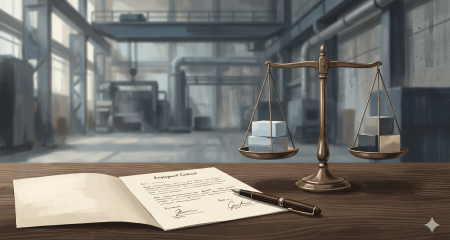
Summary dismissal (ontslag op staande voet) for underperformance almost never holds up. Underperformance is not an urgent reason within the meaning of Article 7:677 of the Dutch Civil Code (BW): the employer must first warn the employee and give a real chance to improve, usually through an improvement plan. Only a separate, serious incident that makes continuing the employment for even one more day unacceptable can justify immediate dismissal.
What is an urgent reason?
An urgent reason is an act, quality or behaviour of the employee that means the employer cannot reasonably be expected to continue the contract. Under Article 7:677(1) BW the dismissal must be given immediately, with the reason communicated to the employee at the same time.
Article 7:678 BW gives examples, such as theft, fraud, gross insult and seriously neglecting duties. The court looks at all circumstances, including the nature and seriousness of the conduct, the employee’s length of service, and the consequences of the dismissal for the employee. A summary dismissal is a last resort.
Why is underperformance not enough?
For underperformance the law has its own dismissal ground. Under Article 7:669(3)(d) BW the employer can only dismiss for unsuitability if it informed the employee in good time and gave sufficient opportunity to improve, and if the unsuitability is not caused by insufficient training or poor working conditions.
That route runs through the subdistrict court (kantonrechter), not through summary dismissal. An employer that skips it by presenting an ordinary mistake as “the final straw” usually loses: one missed task after a period of vague dissatisfaction is not an urgent reason.
An example to illustrate: an employee whose performance has been discussed in general team meetings is dismissed on the spot for placing an order too late. There was no individual improvement plan and no written warning that his job was at stake. In such a case the court will normally find that there was no urgent reason, because the employer should first have followed the improvement route.
What does an employer need before dismissing for underperformance?
A file that shows the employee knew what was wrong and had a real chance to improve. The court tests this strictly under Article 7:669(3)(d) BW.
- Concrete feedback on specific shortcomings, recorded in writing.
- Individual meetings, not only general team meetings, with written reports.
- A formal improvement plan with measurable goals, guidance and a realistic period.
- A clear written warning that the job is at stake if no improvement follows.
- Training or support where the shortcoming is related to skills.
What can the employee claim after an invalid summary dismissal?
The employee can choose: ask the subdistrict court to annul the dismissal, with back pay, or accept the end of the contract and claim compensation (Article 7:681(1) BW). The request must be filed within two months after the contract ended (Article 7:686a(4)(a) BW).
If the employee does not seek reinstatement, the following claims are common:
- Compensation for the notice period: the wages over the notice period that should have been observed (Article 7:672(11) BW).
- Pereinamasis mokėjimas: one third of a monthly salary per year of service (Article 7:673 BW), unless the employee acted seriously culpably; this request must be filed within three months (Article 7:686a(4)(b) BW).
- Teisinga kompensacija (billijke vergoeding): an amount set by the court for the employer’s seriously culpable conduct, taking into account, among other things, the employee’s prospects on the labour market.
Į ką, kaip darbdavys, reikėtų atkreipti dėmesį?
- Is there a separate, serious incident, or is it really about underperformance?
- Can you prove the incident, for example that a clear instruction was given?
- Do you dismiss immediately after discovering the facts and state the reason at the same time (Article 7:677 BW)?
- Is there an improvement plan and a written warning on file if performance plays a role?
- Have you avoided messages that undermine the dismissal, such as an apology shortly afterwards?
Į ką, kaip darbuotojui, reikėtų atkreipti dėmesį?
- Was the reason stated immediately and in concrete terms?
- Did you receive an individual improvement plan and a written warning before?
- Do you want to return, or do you prefer compensation?
- Have you noted the two-month deadline for annulment or fair compensation, and three months for the transition payment?
- Have you kept the dismissal letter, messages and meeting reports?
Ką galime padaryti dėl atleidimo iš darbo be išankstinės registracijos?
Mūsų darbo teisininkai bei atleidimo iš darbo advokatai act for employers and employees. See also kaip išsirinkti darbo teisės advokatą Nyderlanduose.
- We assess within one working day whether the facts amount to an urgent reason.
- We set up an improvement plan and warning letters that meet Article 7:669(3)(d) BW.
- We calculate the compensation for the notice period, the transition payment and a fair compensation claim.
- We file the petition with the subdistrict court within the two-month deadline.
- Kaip alternatyvą teismo procesui, deramės dėl taikos sutarties.
Santrauka
- Underperformance is not an urgent reason for summary dismissal (Article 7:677 BW).
- Dismissal for underperformance requires a timely warning and a real chance to improve (Article 7:669(3)(d) BW).
- After an invalid summary dismissal, the employee can ask for annulment or for compensation (Article 7:681 BW).
- Claims include compensation for the notice period, the transition payment and fair compensation.
- The deadline is two months, and three months for the transition payment.
Dažnai užduodami klausimai
Ar galiu būti iš karto pašalintas už prastą darbą?
Normally not. Underperformance is not an urgent reason under Article 7:677 BW; the employer must first warn you and give you a real chance to improve (Article 7:669(3)(d) BW).
What is the deadline to challenge a summary dismissal?
Two months after the contract ended for annulment or fair compensation, and three months for the transition payment (Article 7:686a(4) BW).
Am I entitled to a transition payment after summary dismissal?
Yes, if the summary dismissal was invalid and you did not act seriously culpably. The transition payment is one third of a monthly salary per year of service.
What must an improvement plan contain?
Concrete shortcomings, measurable goals, guidance, a realistic period and a clear warning that the job is at stake if no improvement follows.