In the Netherlands, owning or carrying a weapon is prohibited unless the Weapons and Ammunition Act (Wet wapens en munitie, WWM) makes an exception. For firearms, that exception is a permit (verlof) or hunting licence (jachtakte) issued by the chief of the National Police (korpschef), only for sport shooting, hunting or collecting, and never for self-defence.
There is no right to bear arms. Permission is tied to one purpose and to specific registered weapons, and as soon as a condition is broken, possession becomes a criminal offence again. That explains why many prosecutions concern people who consider themselves law-abiding. For the wider context, see our guide to baudžiamasis procesas Nyderlanduose.

How does the Act classify weapons?
Article 2 WWM divides weapons into four categories, and the category determines the rules. The numbering does not run from most to least dangerous: firearms are in Categories II and III.
| Kategorija | Pavyzdžiai | Darbo tvarkos taisyklių |
|---|---|---|
| I | Flick knives, butterfly knives, stilettos, knuckledusters, throwing stars, realistic imitation firearms | Prohibited; no permit possible, only specific exemptions (such as for organised airsoft) |
| II | Automatic firearms, disguised firearms, stun guns, pepper spray and tear gas | Prohibited for private individuals |
| III | Rifles, shotguns, pistols, revolvers, certain alarm pistols | Only with a verlof or jachtakte |
| IV | Swords, batons, air guns not resembling a firearm, crossbows, objects intended to injure or threaten | Allowed at home, not to be carried in public |
Parts and accessories specifically designed for a weapon, such as a barrel, frame, magazine or silencer, follow the category of the weapon. Ammunition has its own classification, and holding ammunition without a permitted firearm for it is an offence in itself.
Pepper spray is the most common mistake. It is legal in several neighbouring countries but a Category II weapon here, so bringing it home from abroad is enough for prosecution.
How do you get a firearms permit?
A verlof is issued by the korpschef for a limited period, names the specific firearms it covers and is granted only for a reason the Act recognises. In practice there are two routes for individuals, plus a separate collector’s permit.
- Sport shooting: membership of a shooting association affiliated to the Royal Netherlands Shooting Sports Association (KNSA), in practice for at least a year, with a minimum number of recorded shooting sessions. The details, including the maximum number of firearms, are in the police policy rules (Circulaire wapens en munitie).
- Hunting: a jachtakte, which requires a recognised hunting exam, insurance and access to a hunting field of the minimum legal size.
- Collecting: a collector’s permit allows firearms to be held for their historical or technical interest, but not to be fired, and the collection must have a defined theme.
You must be at least 18. Businesses that manufacture, repair or trade in weapons need a separate recognition (erkenning) tied to a responsible person.
When is a permit refused or withdrawn?
A permit is refused or withdrawn if there is reason to fear misuse of the weapon or the permit (Article 7 WWM). The police do not need to prove that misuse will happen; a reasoned concern based on facts is enough.
In practice that concern can follow from a conviction, a pending criminal investigation, a report of domestic violence, a mental health crisis, threats, alcohol or drug problems, or dishonesty in the application. Withdrawal does not wait for the outcome of a criminal case, and continued possession after withdrawal is itself an offence.
How do you challenge a refusal or withdrawal?
The decision is an administrative decision under the General Administrative Law Act (Algemene wet bestuursrecht, Awb). You must file an objection or administrative appeal within six weeks (Article 6:7 Awb), after which the administrative court can review the case.
The weapons are usually surrendered immediately, so the dispute is about getting the permit back. Because the test is fear of misuse, you need to show that the facts relied on did not happen or no longer create a risk, for example with medical or psychological reports and evidence of completed treatment.

Which conditions apply to a licensed owner?
A verlof is a conditional permission, and the conditions are printed on it. The table shows where the line runs in the situations that most often lead to prosecution.
| Aspektas | Leidžiama | Neteisėta |
|---|---|---|
| Leidimas | A current verlof or jachtakte covering the specific weapon | An expired or withdrawn permit, or a weapon not listed on it |
| Tikslas | Sport shooting at a recognised range, or hunting under a jachtakte | Any other use, including personal protection |
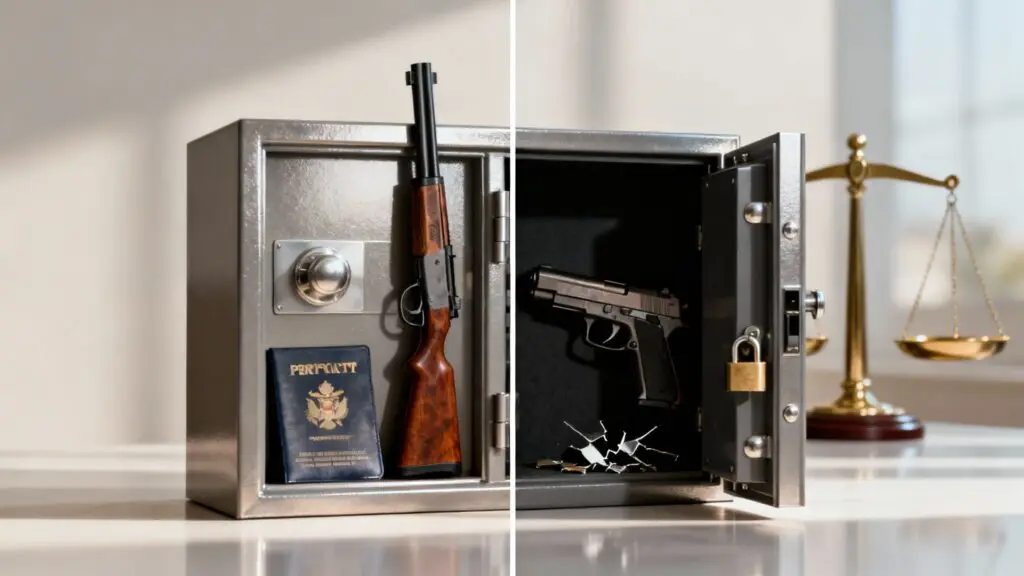
| saugojimas | In an approved locked safe at the registered address, ammunition stored separately | A cupboard, a car or any address the police have not approved |
| transportas | Unloaded, in a closed case, directly between home and range or hunting field | A detour, or a weapon or ammunition within reach |
| Perkelti | Only to a licensed dealer or a person whose permit covers the weapon | Lending, selling or giving it to anyone else, including family |
You must also allow the police to inspect your storage, report a change of address and report loss or theft immediately. If your club membership or jachtakte lapses, the basis for the permit falls away as well.
How does a lawful owner become a suspect?
Prosecutions of licensed owners rarely involve intent to break the law. They follow from ordinary lapses, and the Act does not recognise a grace period.
- The permit lapses because a renewal or club membership is late.
- The route is not direct, for example a stop at a supermarket on the way back from the range.
- Ammunition is kept within reach while the firearm is in the boot.
- The weapon is modified, for example with a sound suppressor, so it no longer matches the permit.
- Someone without a permit gets access, such as a partner who knows where the safe key is.
- A life event, such as a divorce or a police visit after an argument, leads to withdrawal, and the weapons are not handed in.
Which everyday objects count as weapons?
Most weapons cases in the Netherlands have nothing to do with firearms. Flick knives, butterfly knives and stilettos are Category I and prohibited everywhere; an ordinary knife may become a Category IV weapon if the circumstances suggest it is meant to injure or threaten, such as a kitchen knife carried in a jacket pocket at night in a city centre.
Pepper spray, tear gas and stun guns are Category II weapons, and no private individual may carry them for protection. A realistic imitation firearm is a Category I object even if it cannot fire. Municipalities can designate security risk areas (veiligheidsrisicogebieden) where the police may carry out preventive searches without individual suspicion. Carrying a weapon while committing another offence, such as a threat, makes that offence considerably more serious; see our article on užpuolimo kaltinimai Nyderlanduose.

Why is self-defence not a reason to own a weapon?
Dutch law recognises self-defence (noodweer, Article 41 Sr) against an immediate unlawful attack when the defence is necessary and proportionate. It does not allow anyone to arm themselves in advance.
Successful self-defence against an assault does not make possession of the weapon lawful; the weapons charge stands on its own. Carrying a weapon in anticipation of trouble can also weaken the self-defence argument. Our article on baudžiamosios atsakomybės netaikymo pagrindai explains how noodweer is assessed.
Kokios nuobaudos?
Article 55 WWM sets the penalties, graduated by category and conduct: offences involving Category I and IV objects are at the lower end, Category III firearms are serious, and Category II weapons and trafficking are at the top. Possession of a firearm together with its ammunition is punished more severely than either alone.
Under the sentencing guidelines of the Public Prosecution Service (OM), carrying a firearm in public leads to an unconditional prison sentence as the starting point, even if it was never used. Licensed owners prosecuted for a compliance failure more often receive a fine, community service or a suspended sentence, but losing the permit is almost certain.
A conviction is recorded in the judicial documentation system, which affects a certificate of conduct (VOG); see ką reiškia teistumas. For non-Dutch nationals it can affect residence rights; see teistumas ir jūsų teisė likti Nyderlanduose.
What should you do with an inherited or found weapon?
A permit is personal and does not pass to heirs. From the moment you hold an inherited weapon as heir or executor, you possess it without authorisation.
Contact the police before you move it. You can hand it in for registration and destruction, transfer it through a licensed dealer to someone whose permit covers it, or apply for a permit yourself if you already meet the requirements. Voluntary surrender does not automatically end the offence, but the OM takes it into account.
Are antique and deactivated firearms exempt?
Firearms made before 1870 fall under an exemption in the Weapons and Ammunition Regulation (Regeling wapens en munitie), but a modern reproduction of an old design does not. A deactivated firearm is exempt only if it was deactivated to the EU standard, marked and accompanied by a deactivation certificate; keep the certificate with the weapon.
What about import, export and travel?
Import and export of firearms and ammunition require prior authorisation from the Central Import and Export Office (CDIU) of Dutch Customs. Licensed sport shooters and hunters travelling to another EU country need a European Firearms Pass, plus any consent required in the destination country.

What should you do if the police contact you?
Weapons cases usually start with a search of a home or a person. You have the right to remain silent and to consult a lawyer before the first police interview; see ką daryti, jei esate įtariamas nusikalstama veika.
Whether the search was lawful is a real issue in many cases, because evidence from an unlawful search can be challenged under Article 359a of the Code of Criminal Procedure (Sv). Our articles on kai jums reikia baudžiamosios gynybos advokato ir dėl šaukimas ir posėdis explain the next steps.
What can we do for you with weapons law?
Mūsų teisininkai baudžiamoji teisė advise licensed firearm holders and people suspected of weapons offences.
- We file an objection against the refusal, withdrawal or non-renewal of a verlof or jachtakte within the six-week deadline.
- We collect medical and other evidence to address the fear of misuse under Article 7 WWM.
- We advise on handing in or transferring an inherited or found weapon before you contact the police.
- We assist you during police interviews and assess whether the search was lawful.
- We defend you in prosecutions under the Weapons and Ammunition Act.
Santrauka
- Weapons are prohibited in the Netherlands unless the WWM makes an exception; self-defence is never a valid reason.
- Article 2 WWM has four categories; pepper spray and stun guns are Category II and prohibited.
- A verlof is issued by the korpschef for sport shooting, hunting or collecting, and is withdrawn on fear of misuse (Article 7 WWM).
- Most offences by licensed owners concern lapsed permits, transport, storage or access by others.
- An inherited weapon is held unlawfully from day one; contact the police before moving it.
Dažnai užduodami klausimai
Is owning a gun legal in the Netherlands?
Only with a permit (verlof) or hunting licence (jachtakte) issued by the korpschef, for sport shooting, hunting or collecting. Without such a permit, possession is a criminal offence under the Weapons and Ammunition Act.
Is pepper spray allowed in the Netherlands?
No. Pepper spray is a Category II weapon under Article 2 WWM and private individuals may not own or carry it, even if it was bought legally abroad.
Can I lend my licensed firearm to someone?
Only to a person whose own permit covers that weapon. Lending it to anyone else is an offence for both of you.
What happens if my permit is withdrawn?
You must hand in your weapons, because continued possession is an offence. You can file an objection within six weeks and later go to the administrative court.